
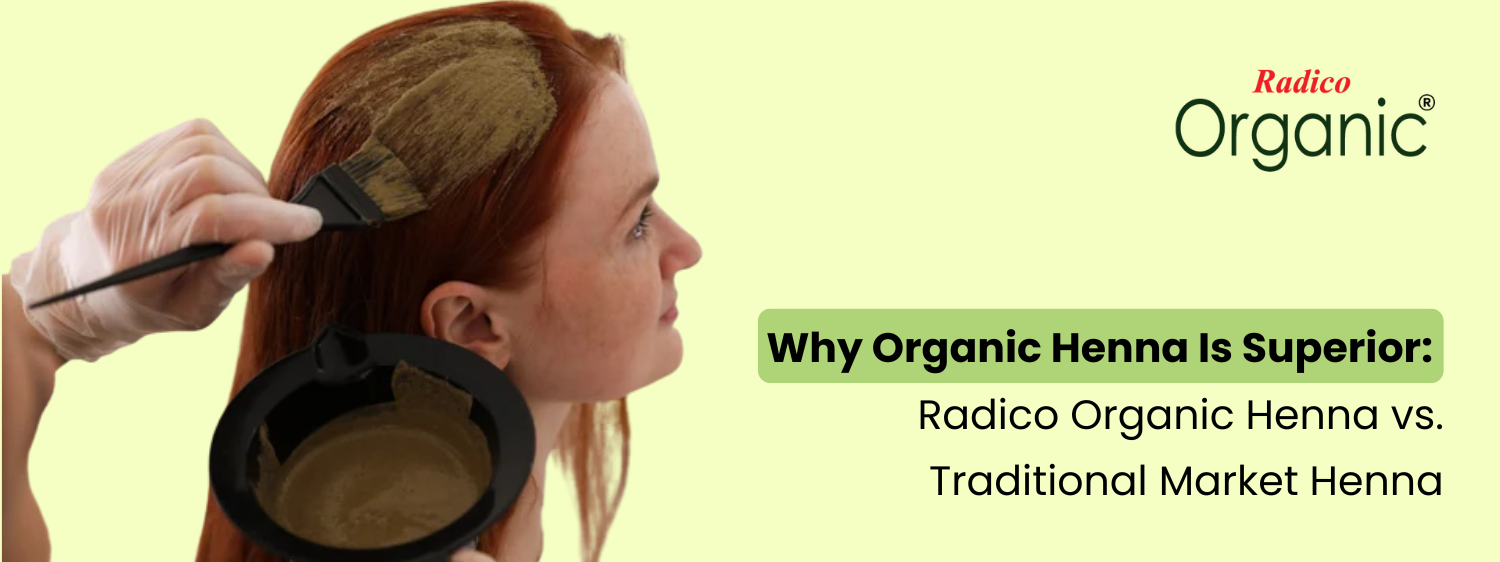
Why Organic Henna Is Superior: Radico Organic Henna vs. Traditional Market Henna
In an era of growing consumer consciousness about personal care ingredients, organic henna has emerged as the gold standard for natural hair coloring and conditioning. Unlike traditional market henna products laden with chemical additives, organic henna—particularly Radico Organic Henna—offers a safer, healthier alternative that delivers both cosmetic benefits and genuine scalp wellness.
This comprehensive guide explains why organic henna is better than conventional alternatives, compares Radico organic henna directly with traditional henna, and details the unique advantages of Radico’s three distinct organic henna powder formulations: Radico Colorless Henna, Radico Organic Henna, and Radico Herbal Henna.
What Is Henna? Understanding Natural Hair Dye Fundamentals
Henna comes from the leaves of Lawsonia inermis, a plant native to the Middle East and South Asia that has been used for over a millennium in traditional medicine and cosmetics. The primary active compound responsible for its natural hair coloring properties is lawsone (2-hydroxy-1,4-naphthoquinone), a natural dye molecule that binds irreversibly to hair keratin, imparting a rich red-orange to brown hue.
Beyond its coloring capability, pure henna powder contains an impressive phytochemical profile: tannins (approximately 11.12% concentration), flavonoids, gallic acid, and natural mucilage. These compounds work synergistically to deliver multiple benefits of henna, from antioxidant protection to antimicrobial action—making henna far more than a simple dye. It is fundamentally a conditioning treatment that strengthens, nourishes, and protects hair while supporting scalp health.
Why Choose Organic Henna Over Synthetic Dyes?
Unlike harsh chemical hair dyes, natural henna for hair operates through a gentle, non-oxidizing mechanism, making it ideal for health-conscious consumers seeking safe hair dye alternatives.
The Problems with Additive-Laden Henna: Why Chemical Additives Are Dangerous
The market is flooded with henna products containing chemical additives designed to accelerate color development, deepen the shade, or extend shelf life. These additives pose serious health risks, and their prevalence is why consumer awareness has become critical.
Para-Phenylenediamine (PPD): The Primary Culprit in Chemical Henna
PPD (Para-phenylenediamine) is the most common chemical additive in henna, particularly in products marketed as black henna or promising instant, darkened results. While PPD is FDA-approved for hair dyes at concentrations below 3%, it is explicitly not approved for direct application to skin. Yet in many black henna tattoo products and some henna hair dyes, PPD concentrations reach 10–40%—a dangerous escalation that creates severe health hazards.
Research shows that 78% of adverse henna reactions involve PPD contamination. Documented PPD health effects include:
-
Severe allergic contact dermatitis affecting the scalp, face, and neck
-
Intense itching, redness, and inflammatory responses
-
Blistering and chemical burns requiring medical intervention
-
Permanent scarring in some cases, lasting months or indefinitely
-
Cross-sensitization, making individuals allergic to structurally similar chemicals (hair dyes, sunscreens, medications)
-
In extreme cases: systemic toxicity, acute renal failure, organ damage
Critical Note on PPD Sensitization: PPD is a sensitizer, meaning that repeat exposure—even without previous reactions—increases the likelihood of severe allergic response. This makes henna with PPD increasingly dangerous over time.
Other Harmful Additives in Non-Organic Henna
Traditional market henna and chemical henna products often contain additional problematic substances:
| Additive | Health Risks | Why It’s Used |
|---|---|---|
| Ammonia | Scalp burns, respiratory irritation, hair damage | Accelerates color development |
| Hydrogen Peroxide | Strips natural pigment, weakens hair shaft, causes brittleness | Oxidizing agent for color |
| Resorcinol | Thyroid disruption, endocrine/nervous system concerns | Color developer |
| Lead and Mercury | Heavy metal accumulation, neurological damage | Contaminant from poor sourcing |
| Chromium | Organ toxicity, allergic reactions | Contamination from processing |
| Kerosene and Solvents | Respiratory irritation, chemical burns | Solvent for mixing |
The FDA sets an upper limit for lead in cosmetics at 20 ppm. Unfortunately, non-organic henna frequently exceeds these standards.
Why Organic Henna Is Better: The Science Behind Natural Hair Color
1. Ingredient Transparency and Certified Purity
Organic henna is certified to stringent international standards—typically USDA Organic (7 CFR Part 205) and ECOCERT (EC No. 834/2007). This certification ensures:
-
100% plant-based ingredients with no synthetic additives
-
Zero tolerance for PPD, ammonia, peroxide, and resorcinol
-
Rigorous testing to prevent heavy metal contamination
-
Sustainable sourcing and ethical farming practices
-
Full traceability and third-party verification
Unlike conventional henna, where ingredient lists may obscure harmful additives under vague terminology, organic henna certification provides transparency and accountability. You know exactly what you’re applying to your hair and scalp.
2. Safety and Scalp Health: Benefits of Pure Henna
Natural organic henna is fundamentally safer for skin and scalp. While approximately 1 in 250 people may experience mild sensitivity to organic henna compounds (compared to much higher rates for PPD), true adverse reactions are rare and mild.
The science is clear: lawsone, the primary coloring agent in pure organic henna powder, operates through a non-oxidizing mechanism. It does not penetrate the hair cortex aggressively; instead, it coats the hair shaft and forms a protective layer. This approach minimizes damage and maximizes conditioning benefits. Additionally, henna’s natural tannins possess anti-inflammatory and pH-balancing properties that soothe irritated scalps, reduce dandruff, and maintain the scalp’s natural acid-alkaline balance—something chemical dyes disrupt.
For whom is organic henna safe?
-
Individuals with eczema or sensitive skin
-
Pregnant women (when approved by healthcare provider)
-
Post-chemotherapy hair care
-
Those with a history of allergic reactions to hair dye
-
Anyone seeking gentle hair conditioning
3. Environmental Impact: Sustainable Organic Henna Farming
Organic henna farming prioritizes ecological sustainability. Certified organic henna producers avoid synthetic pesticides, chemical fertilizers, and environmentally harmful inputs. Instead, they employ:
-
Natural pest management techniques
-
Sustainable water use
-
Soil preservation and crop rotation
-
Biodiversity protection
Moreover, henna itself has been recognized for its environmental benefits: its extracts possess natural antifungal, antibacterial, and antiparasitic properties, making it useful in green biotechnology applications. When you choose organic henna for hair, you support farming practices that heal the environment rather than harm it.
4. Color and Conditioning Benefits: Why Organic Henna Nourishes Hair
Contrary to misconception, pure organic henna is a natural conditioner. The mechanism is simple but powerful: lawsone and other phytocompounds bind to hair keratin, filling micro-cracks on the hair surface and creating a protective coating. This results in:
-
Visible shine and luminosity (within 4–6 weeks of application)
-
Reduced frizz and improved manageability
-
Strengthened hair shaft, reducing breakage and split ends
-
Deep conditioning compared to synthetic dyes, which strip moisture
-
Natural color depth that improves with repeated applications (builds with each use, unlike permanent dyes that fade)
Radico Organic Henna vs. Traditional Market Henna: Complete Comparison
The following table illustrates the stark differences between Radico’s certified organic henna formulations and typical market henna products:
| Feature | Radico Organic Henna | Traditional Market Henna |
|---|---|---|
| Certifications | USDA Organic, ECOCERT, ISO 9001:2015, India NPOP | Often unverified or vague eco-claims |
| Chemical Additives | None (100% plant-based) | Likely contains PPD, ammonia, peroxide |
| Heavy Metal Screening | Certified testing protocols | No guarantee; often contaminated |
| Safety for Sensitive Scalp | Yes; hypoallergenic (0.4% mild sensitivity) | High risk; 78% of reactions involve PPD |
| Hair Conditioning | Natural conditioning, adds shine | Often drying; requires additional treatments |
| Environmental Sourcing | Sustainable, ethical farming | Often pesticide-laden, unsustainable |
| Color Longevity | Semi-permanent (4–6 weeks, builds over time) | Variable; claims often misleading |
| Scalp pH Balance | Maintains; soothes irritation | Disrupts pH; may cause irritation |
| Health Risks | Minimal (0.4% mild sensitivity rate) | Severe (78% PPD-related reactions) |
| Cost Analysis | Higher initial investment; saves on medical/damage costs | Cheap upfront; health costs outweigh savings |
Radico’s 3 Types of Organic Henna: Product Comparison and Benefits
Radico, a pioneering brand with over 30 years of expertise and presence in 100+ countries, offers three distinct organic henna products, each designed for specific hair care needs and scalp concerns.
1. Radico Organic Colorless Henna (Cassia Obovata): Pure Hair Conditioning
Product Composition: Pure Cassia obovata leaves, also called neutral henna or cassia powder.
Key Benefits of Radico Colorless Henna:
-
Pure conditioning without color: Ideal for individuals who desire deep conditioning but no color change
-
Strengthens and nourishes: Rebuilds damaged hair, reduces breakage, and promotes elasticity
-
Improves hair texture: Adds silkiness, reduces frizz, and enhances shine
-
Scalp health: Balances pH, soothes irritation, and maintains clean, healthy scalp environment
-
Safe for all hair types: Particularly beneficial for fine, color-treated, or fragile hair
-
No color commitment: Perfect for testing natural hair treatments before colored henna
Color Result: While cassia doesn’t alter dark hair color, it imparts a subtle golden hue to gray or blonde hair, making it ideal for those seeking neutral toning.
How to Use Radico Colorless Henna:
Mix with warm water to form a pancake-batter consistency; apply to clean hair and leave on for 1–4 hours (longer application intensifies the golden tone). Can be used 1–2 times monthly without risk of damage.
Best For: Hair repair, scalp conditioning, gray coverage, sensitive scalps, pre-henna preparation.
2. Radico Organic Henna (Pure): Traditional Red Hair Coloring
Product Composition: 100% Lawsonia inermis leaves—the traditional red henna containing no added herbs.
Key Benefits of Radico Organic Henna:
-
Natural hair coloring: Imparts vibrant red-orange to deep brown shade depending on base hair color and application time
-
Rich antioxidants and proteins: Contains vitamin E and antioxidants that protect hair from environmental damage and free radical stress
-
Cooling and antifungal properties: Reduces scalp heat, combats fungal growth, and prevents dandruff
-
Deep conditioning: Strengthens hair from root to tip, reduces breakage, and adds luminosity
-
Semi-permanent, cumulative color: Color deepens and becomes richer with each application, creating a personalized shade
-
Cost-effective: Pure henna lasts longer than mixed products; economical for frequent users
Color Result: Rich red-orange on light hair; warm mahogany on medium brown; deep burgundy-brown on dark hair. Color lasts 4–6 weeks and gradually fades naturally.
How to Use Radico Organic Henna:
Mix pure henna with warm water and lemon juice or black tea (acidic component releases lawsone). Apply to clean, damp hair. Cover and leave on for 3–6 hours for optimal color development. Can be enhanced by adding yogurt, eggs, or oils for extra conditioning.
Best For: Natural red tones, gray coverage, hair strengthening, dandruff prevention, cumulative color building.
3. Radico Organic Herbal Henna: Comprehensive Hair and Scalp Care
Product Composition: Pure organic henna combined with four powerful Ayurvedic herbs: Amla (Emblica officinalis), Bhringraj (Eclipta alba), Reetha/Ritha (Sapindus mukorossi), and Shikakai (Acacia concinna).
Herb-Specific Benefits:
Amla (Indian Gooseberry):
-
Rich in vitamin C and antioxidants
-
Promotes hair growth and prevents hair loss
-
Nourishes roots and conditions hair for natural shine and bounce
-
Reduces premature graying
Bhringraj (False Daisy):
-
Called “the king of herbs for hair” in Ayurveda
-
Promotes new hair growth and stimulates follicles
-
Adds shine and luster
-
Strengthens roots to prevent premature graying
Reetha (Soapnuts):
-
Natural cleanser and natural shampoo alternative
-
Promotes hair growth and improves texture
-
Adds volume without synthetic sulfates
-
Mild enough for daily cleansing without stripping scalp oils
Shikakai (Acacia):
-
Natural cleanser compatible with henna
-
Restores scalp health and treats hair fall
-
Detangles and reduces dandruff naturally
-
Conditions for manageable, lustrous hair
Combined Benefits of Radico Herbal Henna:
-
Enhanced conditioning: Herbal blend creates synergistic effect, delivering superior nourishment compared to pure henna alone
-
Scalp restoration: Specifically targets dandruff, scalp irritation, and oiliness through multi-herb action
-
Hair growth promotion: Bhringraj and Amla work together to stimulate follicles and encourage thicker, healthier growth
-
Anti-dandruff action: Shikakai and Reetha provide natural antimicrobial and cleansing properties without harsh chemicals
-
Color with comprehensive care: Colors hair while treating underlying scalp and follicle issues
-
All-in-one treatment: Reduces need for multiple products
Color Result: Similar to pure henna (red-orange to deep brown) but with enhanced depth and shine due to herbal conditioning.
How to Use Radico Herbal Henna:
Mix with warm water to reach desired consistency. Add yogurt, egg, olive oil, or coconut oil for intensified conditioning. Apply to hair and scalp, leave on for 3–4 hours. Ideal for those experiencing hair loss, dandruff, or seeking maximum hair health benefits alongside coloring.
Best For: Hair loss prevention, dandruff treatment, scalp health restoration, comprehensive hair care, maximum conditioning benefits.
Radico Henna vs. Other Brands: Why Radico Stands Out
| Criterion | Radico Organic | Non-Organic Henna | Other Organic Brands |
|---|---|---|---|
| Brand Experience | 30+ years heritage | Often new/unverified | Varies |
| Global Presence | 100+ countries | Limited distribution | Regional focus |
| Certifications | USDA, ECOCERT, NPOP, Halal | Minimal/none | Varied certification |
| Product Range | 3 distinct formulations | Usually 1-2 options | 1-2 formulations |
| Quality Consistency | Batch-tested, verified | Inconsistent quality | Generally good |
| Transparency | Full ingredient disclosure | Often vague | Good disclosure |
| Price Point | Mid-premium | Budget/premium | Mid-premium |
| Customer Reviews | Highly rated (4.5+ stars) | Mixed reviews | Generally positive |
How to Choose the Right Radico Henna Product for Your Hair
Decision Tree for Radico Henna Selection:
Step 1: Determine Your Primary Goal
-
Goal: Conditioning only → Radico Organic Colorless Henna
-
Goal: Natural red color → Radico Organic Henna (Pure)
-
Goal: Color + hair growth/dandruff treatment → Radico Organic Herbal Henna
Step 2: Consider Your Hair Condition
-
Damaged, color-treated hair → Start with Colorless Henna
-
Healthy hair wanting color → Radico Organic Henna
-
Hair loss or scalp issues → Radico Organic Herbal Henna
Step 3: Assess Your Commitment
-
First-time natural dye user → Colorless Henna (test patch)
-
Experienced with natural dyes → Organic Henna
-
Long-term hair health focus → Herbal Henna (use regularly)
Application Tips for Maximum Radico Henna Benefits
Pre-Application Preparation:
-
Perform a patch test 48 hours before full application (mix small amount, apply behind ear)
-
Prepare your space with old towels, plastic sheets, and protective clothing
-
Use filtered or bottled water (chlorine can interfere with color development)
-
Mix henna in non-metal bowls (use ceramic or glass)
Mixing Recommendations:
-
Basic mix: Henna + warm water (180°F) until pancake-batter consistency
-
Enhanced conditioning: Add 1 tablespoon coconut or olive oil per 100g henna
-
Color enhancement: Add lemon juice or black tea (acidic medium releases lawsone)
-
Scalp soothing: Mix with yogurt or raw egg
Application Process:
-
Section hair into 4-6 sections using clips
-
Apply from roots to ends, massaging into scalp
-
Cover head with plastic wrap or shower cap
-
Leave on for 3–6 hours (longer = deeper color)
-
Rinse thoroughly with lukewarm water until water runs clear
-
Condition lightly with natural conditioner (avoid sulfates)
Post-Application Care:
-
Avoid washing hair for 24-48 hours to allow full color setting
-
Use sulfate-free shampoo for future washes
-
Deep condition weekly to maintain shine
-
Repeat every 4-6 weeks for color maintenance
Common Questions About Radico Organic Henna
Q: Will organic henna damage my hair like chemical dyes?
A: No. Organic henna is a conditioning treatment, not a damaging dye. It strengthens hair, reduces breakage, and adds shine—the opposite of chemical dyes that strip protein and moisture.
Q: How long does Radico henna color last?
A: Semi-permanent color lasts 4–6 weeks, gradually fading naturally. Color deepens with repeated applications (builds over time, unlike permanent dyes that fade).
Q: Can I use Radico henna if I have a sensitive scalp?
A: Yes. Radico’s organic certification and PPD-free formula make it ideal for sensitive scalps. Perform a 48-hour patch test first.
Q: Is Radico henna safe during pregnancy?
A: Consult your healthcare provider. Generally, pure organic henna is considered safe during pregnancy, but approval depends on individual circumstances.
Q: How does Radico Colorless Henna differ from hair conditioner?
A: Colorless Henna (Cassia) contains unique tannins and phytocompounds that strengthen hair shaft at a deeper level than standard conditioners. It provides semi-permanent conditioning benefits that build over time.
Q: Can I mix the three Radico henna types together?
A: Yes, mixing is possible, though each product is formulated for specific benefits. Consult Radico’s guidelines or speak with a natural hair expert before mixing.
Conclusion: Why Organic Henna Is the Superior Choice
The choice between organic henna and traditional market henna is ultimately a choice between health and risk, sustainability and degradation, transparency and deception. Organic henna—especially Radico’s certified formulations—represents a paradigm shift in natural hair care: products that deliver genuine color, conditioning, and scalp benefits without the chemical hazards that plague conventional alternatives.
With 78% of adverse henna reactions tied to PPD-contaminated products, and with 95% of reactions being entirely preventable through pure, organic alternatives, the evidence is compelling. Radico Organic Henna’s three product lines address diverse hair needs while maintaining uncompromising standards for purity, safety, and efficacy.
For health-conscious consumers seeking natural, sustainable, and genuinely effective hair care, Radico Organic Henna is not merely an alternative—it is the superior choice. Your hair and scalp deserve the nourishment that only pure, certified organic henna can deliver.
Ready to experience the Radico difference? Choose the henna product that aligns with your hair goals and scalp needs. Your healthier, more vibrant hair awaits.