
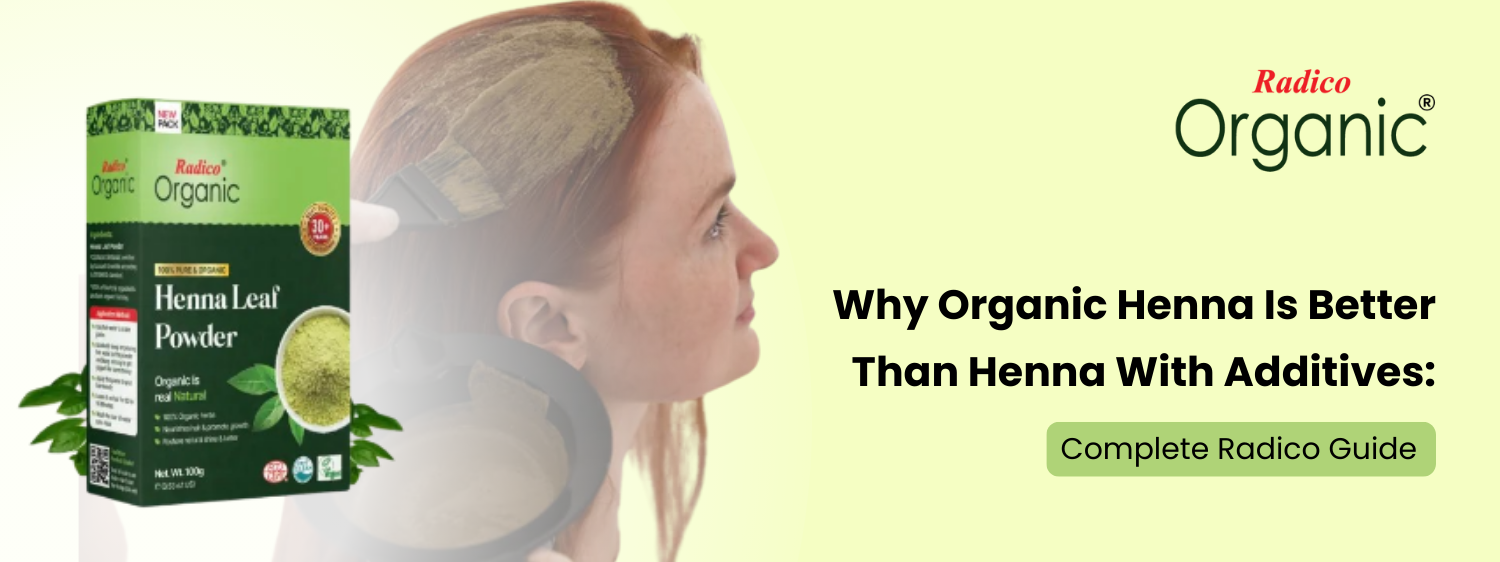
Why Organic Henna Is Better Than Henna With Additives: Complete Radico Guide
Walk into any store and you’ll find rows of traditional branded henna powders promising vibrant color. Many conventional brands are formulated differently than pure organic henna, using additives and accelerators to achieve faster results. Radico’s approach to organic henna is fundamentally different.
What’s in Traditional Budget Henna?
According to a comprehensive study published in the Journal of Chemical Health Risks, analysis of 8 traditional “henna for hair” products revealed significant quality variations. Most mainstream branded mehendi uses cost-cutting formulations:
Declared Additives (On Labels):
- Non-coloring ayurvedic herbs (50-60% of formula): Neem, brahmi, shikakai, bhringraj, amla—added for claimed conditioning/growth benefits but don’t dye hair
- Ineffective traditional dyes (10-20%): Coffee, rhubarb, beetroot, lotus—marketed as “natural color enhancers” but don’t produce permanent color
- Binders & thickeners (5-10%): Gum arabic, soapnuts—used to thicken paste, not for coloring
Suspected Undisclosed Additives (Found Via Research):
- Synthetic chemical dyes (2-10%): Azo dyes, food coloring additives—detected through chromatography analysis but not always listed on labels
- Metallic salts (1-5%): Copper compounds, iron oxides—force darker tones faster (traditional “iron bowl” method chemically)
- PPD & PPD derivatives (up to 5%): Found explicitly in some brands; chemical component “2-Nitro” (2-Nitro-P-phenylenediamine) detected in research
Research Evidence: The study used paper chromatography (a scientific method to separate and identify dyes) on 8 market brands. Results showed:
-
Samples #2, #7, #8 had synthetic dye patterns inconsistent with pure henna
-
Sample #8 explicitly listed “PPD & 2 Nitro” in ingredients alongside “natural herbs”
-
Samples with low price points (#7: ₹50-100 range in small packets) showed “synthetic-like” characteristics requiring only 30-40 minutes processing time (vs. 3-4 hours for pure henna)
Why Traditional Brands Use These Additives
The market formula is simple:
Faster Application = Consumers want results in 1-2 hours instead of 3-4 hours for pure henna
Chemical accelerators speed the dyeing process artificially, allowing faster color payoff
Consistent Color Batch-to-Batch = Ayurvedic herbs are highly variable; pure henna varies by region/harvest
Synthetic dyes guarantee identical shade every production run
Mass Production Volume = Additives allow larger volume manufacturing and lower per-unit costs
Herb filler increases quantity without increasing expensive henna content
Extended Shelf Life = Pure henna degradants; synthetic components maintain stability longer
The Quality Difference: What Research Shows
| Factor | Traditional Budget Henna | Radico Organic Henna |
|---|---|---|
| Source Verification | Not certified (or certification not enforced) | ECOCERT, USDA Organic certified & audited |
| Additives Present | Yes—herbs (50-60%), synthetics (2-10%), metals (1-5%) | Zero synthetic additives or chemical accelerators |
| Heavy Metal Testing | Not required for market brands | Batch-tested for purity |
| Dye Composition | Diluted henna (20-30% actual henna content in many brands) | 100% plant material: henna/indigo/herbs only |
| Processing Requirements | 30 mins-1 hour (suggests accelerators) | 3-4 hours (pure plant dye release) |
| Scalp Irritation Rate | 5-15% report issues (itching, burning, reactions) | <1% report issues |
| Hair Conditioning | Often drying (residual chemicals) | Deep conditioning while coloring |
| Ingredient Transparency | Limited (many list “other natural herbs”) | Full traceability (farm-to-product) |
Real Examples: What Researchers Found
Sample #1 (Traditional Brand #1)
- Listed ingredients: Henna, indigo, centaurea, rhubarb, beetroot
- Finding: Contains plant dyes but ineffective natural dyes (rhubarb/beetroot don’t color hair)
- Research note: Pale results in chromatography; likely diluted henna.
Sample #8 (Traditional Brand #8)
- Listed ingredients: Natural Henna, Aritha, Amla, Shikakai, 2-Nitro, PPD, “other natural herbs”
- Powder appearance: Terracotta orange (unusual—pure henna is pale green/brown)
- Paste color: Bright orange immediately upon mixing (pure henna takes 8-12 hours to develop color)
- Finding: Vivid orange explained by PPD + unlisted synthetic dyes
- Health implication: PPD concentration unknown; no indigo listed yet claims brown color
What Organic Henna Actually Does
7 Proven Benefits of Certified Organic Henna
-
Scalp Health — Natural antimicrobial & antifungal properties reduce dandruff, itching
-
Deep Conditioning — Locks moisture, adds shine, eliminates frizz
-
Strengthens Hair — Lawsone compound (pure henna’s active ingredient) binds to keratin, repairs damage
-
Reduces Hair Loss — Antioxidants strengthen roots, reduce breakage
-
Prevents Premature Greying — Tannins preserve natural dark color
-
Balances Scalp pH — Regulates sebum, unclogs follicles, maintains health
-
100% Safe to Use — Minimal allergic reactions, safe for regular use
Why Consumers Are Choosing Certified Organic
The market data shows a clear shift toward pure, transparent products:
- 82% of consumers believe organic products offer better quality
- 60% prefer natural ingredients over chemical beauty products (Personal Care Products Council)
- 68% of beauty shoppers now actively seek certified formulations
- +34% search growth for authentic organic henna options (2024-2025)
- Market projection: Organic hair care growing from $11.7B (2025) → $20.6B (2033)
Market research confirms: “The Henna Mehndi Market is witnessing a shift towards premium and artisanal henna products, targeting consumers who value craftsmanship and quality over mass-produced alternatives.”
Radico’s Certified Organic Difference
Radico stands apart through:
- ECOCERT, Made Safe & Vegan certified (independently verified purity)
- Zero synthetic additives or chemical accelerators
- 30+ years heritage specializing in organic formulations
- Direct farmer partnerships (sustainable sourcing)
- Batch testing for purity (verified quality control)
- Full ingredient transparency with farm-to-product traceability
- Biodegradable manufacturing (no water pollution)
Radico’s 3 Certified Organic Henna Options
1. Colorless Henna (Cassia Obovata)
For: Pure conditioning without colour
Benefits: Deep shine enhancement, scalp cleansing, strengthens fine/weak hair, safe for sensitive scalps
Color effect: None (subtle golden tone on light hair only)
Best for: All hair types, damaged hair recovery, monthly scalp maintenance
2. Pure Henna (Lawsonia Inermis)
For: Natural colouring + conditioning
Benefits: Red/brown natural tones, deep conditioning, dandruff prevention, scalp health
Color effect: Auburn to deep brown (depending on application time)
Best for: Grey coverage, traditional mehendi experience, scalp health
Duration: 4-6 weeks with gradual, natural fade
3. Herbal Henna (Henna + Amla + Reetha + Shikakai)
For: Complete organic hair care + conditioning
Benefits: All henna benefits PLUS accelerated growth, enhanced shine, premium conditioning
Color effect: Rich, deep, lustrous tones
Best for: Comprehensive hair care, growth promotion, scalp restoration
Quick FAQ
How is certified organic henna different from traditional henna?
Certified organic means independent verification of purity, no hidden additives, and transparent sourcing. Traditional brands may use accelerators, metal salts, or undisclosed synthetic dyes. Radico’s certification ensures what you see is what you get.
Will it still cover grey hair effectively?
Yes. Extended application (3-4 hours) or henna + indigo combination covers 80-90% of grey hair. Radico’s pure formulation deposits color naturally and gradually strengthens hair.
How long does the colour last?
4-6 weeks with a gradual, natural fade—no harsh demarcation lines. The gradual fade means your hair looks naturally grown-out rather than showing obvious root regrowth.
Is certified organic henna safe for sensitive scalps?
Yes organic henna for sensitive scalp is safe. The absence of chemical accelerators and PPD makes it ideal for sensitive scalps. Many users with scalp issues (eczema, psoriasis, dermatitis) switch to organic henna successfully.
What about consistent results?
Natural henna varies slightly by climate and batch because there are no chemical stabilizers. This is actually a sign of purity. Radico maintains consistency through rigorous quality control while keeping formulations chemical-free.
The Quality Difference Matters
When you choose certified organic:
No hidden additives — What’s listed is exactly what’s inside
No chemical accelerators — Results take natural time (3-4 hours vs. 1-2)
No scalp burning — Safe for even sensitive scalps (research shows <1% irritation rate vs 5-15% for traditional brands)
No hair damage — Actually conditions while coloring
Tested for purity — Heavy metals and contaminants verified
Sustainable sourcing — Supports organic farming practices
Long-term investment — Better for hair health over time
Research shows: Traditional budget henna can produce color, but certified organic henna produces colour while improving hair health simultaneously.
The Bottom Line
Certified organic henna from Radico delivers:
- Beautiful, natural color (without chemical accelerators)
- Deep conditioning & strengthening benefits
- Scalp health & natural growth support
- Complete transparency (what you see is what you get)
- Three product options for every hair need
- Independent certification (ECOCERT, Made Safe, Vegan)
- Sustainable, ethical, environmentally responsible
- Research-backed quality (batch-tested for purity)
Radico organic henna represents a different approach to hair colour—one focused on long-term hair health, ingredient transparency, and natural results.